Return to the Ponds

The sun was in a teasing mood and inviting us locals to try a restorative walk. Before I had traveled two hundred yards, it was back in hiding and remained there for the rest of the afternoon. I did the polite thing and pretended not to notice. First, I checked the river. It was higher than ever and running very fast. One of the benches along the bank had disappeared; either it is hiding underwater or has been swept away.
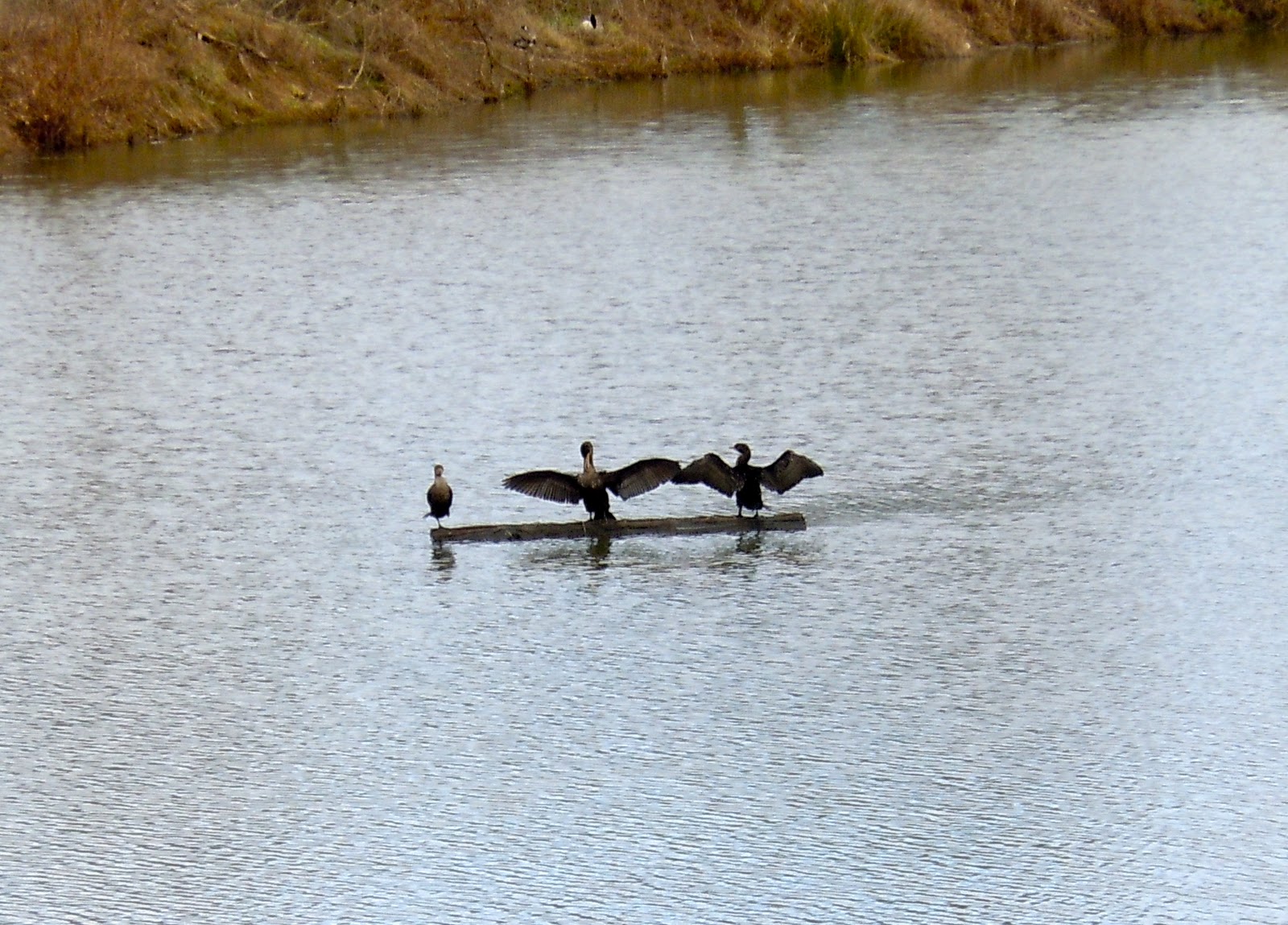
Although the pond level is still high, and may still be rising slowly, the cloudiness has fallen. The birdlife now seems to be returning with pairs of geese occupying prime sites on the banks and islands. The cormorants are back in place and drying out after fishing activity. The heron may not have done so well though as it has taken to a log instead of the bank. Contemplating the benefits of a vegan diet perhaps. 

Maybe though, he is feeling more fortunate than Gena from Dnipropetrovsk in the Ukraine. Poor Gena, while posing for a photo-shoot, yawned on being asked to smile, and then accidently swallowed a cell-phone dropped into her mouth by the would-be photographer, a Mrs. Golovko. Gena, an immigrant crocodile from Africa, is refusing to answer any more calls and is complaining that the ringing in her stomach is quite putting her off her food. Gena is currently eschewing favorites like live quail as they have been injected with laxatives. She is convinced that the photographer’s (Ms. Golovko) hurry to get her sim card returned with her contact list is just a passing fancy.


Micro-farming


There was a plethora of items in the media this morning on communication and cooperation in various species of wildlife. Very humbling for us humans as we usually assume that we invented everything. The most unexpected gem shining from the spoil was the letter to Nature (1) by Brock et al. They have been up to their armpits in the social amoebas known as slime mold. These characters live on bacteria and when the local supply and demand has gone critical, they gather together into a fruiting body – somewhat like their version of the Mayflower – and sail off on the prevailing currents to pastures new. BUT (and note that it is a big ‘but’) a third of the immigrants are farming specialists and carry enough bacteria with them to start new gardens and so prosper in their new world. One is left to wonder if the other two-thirds are lawyers.

Further up the food chain were items on communication of information within a group. Prairie dogs, for example, have a high-pitched squeak and thanks to NPR, I learnt that there is richness in those squeaks that we humans miss. Not surprising, as I have never learnt prairie dog and most foreign languages come across as a sonic blur to my untutored ear. Computers with microphones are much more adept at analyzing the noise. Prairie dogs apparently tell their friends and family the difference between a triangle and a circle. More exciting than that though is that they described people by their shape, or at least height and width, as well as by the color of the tee shirt that they were wearing as they paraded through the colony. There was no translation of the bulk of the chatter though so we don't know what they thought of the designs.

We were also reminded from a different station, that capuchin monkeys get teed-off and refuse to cooperate in monkey psychology tests if they get consistently short changed. Also that crows have great face recognition and ill pass on to their kids which nasty guy is likely to mess with their nests. There were items about chimps and baboons and one about sharks probably being color-blind (so they won’t be put off by the sight of blood?), but I wonder why there is such an element of surprise when these observations are published – shark items apart of course. Cooperation and communication are vital characteristics for species survival. Even animals that prefer to live alone get together for a good time occasionally, just like the rest of us.

Ref:
1. http://www.nature.com/nature/journal/v469/n7330/full/nature09668.html

Pondering the Depths


Bufflehead Flotilla

The morning chill is making my eyes water as I hike to the coffee pot this morning. The pond level is at the highest that I’ve seen it so far. The connective routes from sub-pond to sub-pond are now much broader. The islands have shrunk and some trees have their lower half submerged. A very turbulent inflow has turned the water universally brown with fine particulates carried in from the river.

The wildlife are very quiet this morning with a few disconsolate looking geese staring out across the water. The odd one finds the energy to honk in a half-hearted manner as I walk past. A small flotilla of Buffleheads are continuing to tough it out, but otherwise most of the ducks, geese, heron et al have moved off. Where to? The river is very high and turbulent and even more cloudy, so that wouldn’t be good. As I watch and wonder, a sole cormorant swoops in to waterski to a halt; the call of her home log being too strong to ignore for long, perhaps. With a drier spell of weather predicted, the river level should drop and maybe the ponds will have more excitement to offer.

Designer Genes


An interesting result of a genetic study carried out by Prof. Fowler and colleagues, which is published in PNAS (1), indicates that our genes influence our relationships. Assortative mating so that we tend towards the same set of genes doesn’t sound to surprising but taking it to the extent that we like to share genotypes with our friends seems surprising, at least to me. DRD2 is the beasty that sorts us out apparently. When I read that this is the one that is also associated with a tendency towards alcoholism, I began to see that the popularity of bars takes on a deeper meaning and singles bars must have an even deeper significance. The CYP2A6 genotype was shown to exhibit heterophilly, that is these are people that we wouldn’t like to hang out and drink with.

We need an iPhone App that stores our genotype information and can compare this with others in the same space. Bluetooth technology has a 30-foot radius and would be ideal. Think of the time and money that this would save, we would just have to give the bar a quick scan and our App would give us the probability of having an interesting evening. It would rate the bar on the percentage of the denizens that were boozy soul mates compared to the percentage that were going to tell us boring stories about work or their brother in law’s sister’s dog. Until the App is here, I guess I’ll have to rely on my old standbys of pheromones and non-verbal communication.

A real challenge comes with our Facebook friends. Should we publish some genotype information along with our favorite films and music? Would prospective employers want to compare your genotypes with others that would be in the same team as a compatibility check? Setting up ‘tiger teams’ in the workplace is well established, but are we going to see ‘metagenomic teams’, or better still ‘metagenomic tiger teams’, as the newest fad from the business consulting world?

Whilst sitting here, comfortably in my metagenomic world, I begin to worry about how epigenetics can play into this. If environmental factors can cause genes to become inactive/unavailable due to say modification of a histone tail or the addition of a methoxy group, and this reduction in activity can be passed on for a generation or two, is it possible that I could suddenly end up in a feud with my metagenomic group which could last through to my grandkids time?

Reference:

Collateral Gain


It is always fascinating to see that the collateral changes that we get alongside a planned environmental change are invariably unexpected. Ella Davies in the BBC Earth News today reports on the re-introduction of beavers in Poland. Now we have known, from the work of University of Alberta scientists carried out several years ago, that beavers are good for frogs. Beaver ponds are good homes for tadpoles and I’m sure that over a glass of wine in a bar, I would have been rash enough to predict that. But that beavers are good for bats would not have been on my list. I’m sure it was a surprise to the researchers at the University of Gdansk who spotted it.

Of course we have to climb the causal tree to find out why. Water of course is good for insect populations, so that might be it. But, surprise, the bats that hunt over water (such as Daubenton’s bat) aren’t favored. The reason? These bats use the water surface to reflect their hunting sonar to light up insects and the still water of the beaver ponds get a duckweed blanket giving a stealth surface that hides the insects. The favored bats are those that hunt high up among the trees. The thinning of the trees means fewer small branches and twigs making it easier for these species of bat to locate and catch insects.

It is a little over eighteen months since beavers were re-introduced to Knapdale in Scotland, so it is too early to see wildlife synergies, but a fine time to look to see if they develop. The UK’s bat population is in a pretty dire state and an army of beaver conservation volunteers would be a very cheap way to give them a hand up without increasing the tax rate. Also I’m sure that the current citizenship of Inverness wouldn’t do what their 17th century ancestors did – namely to hunt the beavers for their fur and eat their tails as a substitute for fish
 ( http://news.bbc.co.uk/2/hi/uk_news/scotland/glasgow_and_west/8187637.stm ).

Tea with Your Ant


After taking my morning cup of Assam tea over to the computer to drink while I checked out the news items online, I picked up a BBC news item from the 12th of January on the careless use of pesticides around some of the Assam tea gardens just outside the beautiful Kaziranga National Park. Assam nestles between Bhutan and Burma in northeast India and produces a large amount of tea, which I for one find essential to my daily wellbeing. Kaziranga is home to an abundance of wildlife. However, two pregnant elephants had left the park to sample the greener grass over the hill and had then died from pesticide poisoning. It takes a lot of pesticide to kill an elephant and even more to kill two. Many cows had already succumbed, as had the vultures that started to tidy up.

Why was such death and destruction sown around the tea gardens? Apparently to kill the ants. The local red weaver ants (Oecophylla), also known as fire ants, of using their larva as glue-guns to stick the edges of leaves together – they don’t bother with neat stitching. They’re upwardly mobile, living in the trees and not in nondescript holes in the ground. This tends to keep the trees free of other pests and they are used as front-line bio-control troopers in mango and citrus orchards with considerable success.

 It is clear that glued up tender leaves would not be desirable for my morning tea, but neither would pesticide loads that would kill an elephant! Some of the tea gardens have gone organic and others may well do so or at least support a pesticide ban. But maybe there could be a lesson from the Asian super-ant (Lasius neglectus). It is a black ant, not a red one, and is less aggressive but has an interesting proclivity as outlined in an old BBC report from last August. Then they reported from Hidcote Manor, a National Trust house in the UK, that this variety of Asian ants had a passion for electricity that exceeded their desire for food and drink. They caused some little havoc by forming huge clusters in fuse and junction boxes causing an unreliable electrical supply as they got a big charge out of there rave. Maybe solar panels connected to electrified collection boxes could tempt the fire ants away from the first flush tea bush tips. Who knows but maybe the collected ants could be re-settled in fruit orchards if the voltages were set at the correct level.

Footnote
                 I would love to hear the etymology of the entomological name Lasius neglectus. It can't be as comical as I think!

More of the Same


Another damp day. The sky is like a steel-grey cloud-umbrella with lighter, more hopeful colors showing on every horizon. The ponds are generally quiet and still, save for a group of three geese, necks arched and honking like the last trump in an attempt to discourage the landing of a fourth goose on their island. The inflow to the pond is still fast and the level is rising so maybe the geese are planning ahead. The rapid influx of river water has resulted in this end of the ponds being brown and cloudy. Maybe this is why my heron is sitting, hunched and looking thoroughly teed-off and hungry.

Further up, the ponds are clear as the particulates have sedimented out. Here a flotilla of Buffleheads are diving in unison and popping up still in formation. Very nice and tidy, as are their outfits. They will easily succeed in the audition for ‘Pond Cheerleaders’. No one else comes near to this display of synchronized swimming, if their beaks were flexible, they would be wearing fixed smiles. The other groups of ducks that stick together are more difficult to identify. The males and females have coloring like Ruddies but the males have Merganser-like crests. They migrated here at same time as the Buffleheads but to me they remain mysterious and in disguise.

Our adventurous slugs are out again, but today they have eschewed their unidirectional travel. Their headings appears much more random, with many bending round to head home to follow those who have already made that wise decision as the allure of the excitement on the blacktop fades in comparison with cozy plenty of the grassy herbage of home.

Matter of Moment


A day of sun and showers lures me to check out the pond albeit a little later than usual this morning. It has a very peaceful look today, with only a few ducks leaving nice vee-wakes as they rush from the bank at my approach. There is a cluster of one-legged geese on an island relaxing in close unison. If one falls off its leg, the others will go down like dominos. However, there is no mischief-maker there to give one a push.

Even the heron seems to have had her breakfast as she sits on a downed tree on the bank preening her untidy and long gray feathers. As she spots me, the preening goes to hell in a hand basket and her neck gets very long. But as I continue my walk, it gets shorter with each step until she’s lost it completely as I draw level. I wink but she gives me the brush off as usual and gets back to trying to decide between fish and frogs for lunch.

Suddenly I notice that a dozen or two hardy, but foolhardy, small slugs have forsaken the grass and herb shelter of the verge, lured away by the promised delights of the blacktop just five feet away across the moist concrete. Just like the last time I saw them, they are all on parallel courses to the road but not taking the shortest route. If the sun wasn’t hiding behind the skirts of a large motherly cloud, they would have been lined up with the sun’s rays on their back providing them with the maximum warmth. With no sun having been visible for a little while, they seem to be taking this all on trust.

Leaving the bookstore on my return journey the light shower turns nasty and my pace becomes ‘with purpose’. The slugs have clearly thought better of their foolishness and my thoughts turn to the question of was a thunderstorm forecast. Not a nice thought to linger on as the ground is flat and open. Whilst bolts of lightning are bad enough prospects, the recent news from the Fermi-lab that thunderstorms spew out streams of anti-matter make dawdling even more unattractive than the water running of my coat onto the back of my trouser legs. Might some jogger find just a pair of smoking shoes on the sidewalk and wonder how could someone spontaneously combust in a rainstorm?

Wine and Starlings


There have been reports in the news of several flocks of birds mysteriously dying in different countries around the world. The UK papers today (the Guardian, Telegraph and Mail) all focus on the Romanian starling flock drop. The autopsies indicated that the cause of the drop was a drop too much. The birds had gorged themselves on the crushed grape–yeast feast discarded by a local vintner as being of no further interest to him. The starlings clearly disagreed with this conjecture and set out to prove their case, and in doing so, drunk themselves to death. There is no indication that the birds in the other incidents in Sweden and the US had been partying.

It is interesting to note that just across the Black Sea from Romania lies Armenia, and the BBC reported that the earliest archeological evidence of wine making was recently discovered in a cave there. This means that the danger to local birdlife of overindulgence has been around for about 6,000 years. Even more apposite to the problem is the fact that burial mounds surrounded the archeological winemaking kit. The sober archeologists suggested that indicates that the wine was purely for ceremonial purposes. One is left to wonder if perhaps it was the quality of the wine that left a lot to be desired. In any case the local starlings need to activate their Twitter accounts as their tweets have clearly been ineffective to date in spreading the word of the dangers of alcohol abuse and where they can join a 12-hop program.

Foggy Dew


It’s a chill, foggy day with the sun showing as a pale disc surrounded by a diffuse glow as its rays try and bite through the mist. Fog droplets condense on the bare tree branches and give a constant patter of drips onto the fallen leaves as an accompaniment to my steps. The pond level has been allowed to drop and everyone is very sedate this morning. Maybe the ducks and geese are finding it easier to reach choice morsels below the surface as they upend, so everyone is replete and in a good mood. The cormorants are in their proper positions, surveying the scene like lords of the ponds, unchallenged by belligerent goosey usurpers.

Further on, more than a dozen volunteers from the local Lion’s Club are at work on a sub-pond. They are cleaning up the fringe and planting the bank. Chilly work that requires that lots of coffee is drunk. A long table has been prepared with large pots, paper cups, sugar and cream. Temptation is strong, but I press on.

By the time that I reach the pet store with its auto-doors that snap voraciously at me as I hurry past, my scarf and hat are moist with condensed fog; my one and a half miles to my morning coffee is almost over.

There at last, I settle at a table and notice that the bookstore is ready for the population’s effort to keep their New Year’s resolutions. A large table is set out with ‘dieting tools’ – self help books, calorie tables and personal logs. We’re ready to move into an austerity phase after the indulgencies of the holidays. Feast, then famine is the traditional rollercoaster that we’re all stuck with.

Small World


Have you pondered and lost sleep over what happens to a leaf cutter ant when her teeth get worn down and she can’t cut it anymore? Is she reduced to bringing smaller and smaller bits of leaf back home until she gets laid off, or does she get left out there on her leaf, gumming away the rest of her days?

                                                                                              Gaurdian.co.uk

  A collaborative etymological project from guys at the U of Oregon and Oregon State U – the Ducks and the Beavers for the sporting types amongst us – have settled the issue. She changes her job. She takes up carrying leaf parts for the young blades who can slash with abandon, thus improving the efficiency of the whole operation and getting more leaf bits back to grow the fungi that the stay-at-homes are farming. A nice laid-back approach to career progression, no hanging onto jobs to avoid loss in status there.

Another exciting snippet from the insect world comes from the scientists at Yale who have been checking out the amorous behavior of the Squinting Bush Brown butterfly. Flashing each other is their preferred approach to getting together. Males like to do their flashing in the moist weather, leaving the females to get their own back by flashing at the males in the dry season. They have white centered spots on their wings that reflect ultraviolet light for effective flashing, maybe that’s why they are reduced to squinting. 

Snow at Salt Creek


A clear, crisp, sunny day and an expedition snowshoeing into see Salt Creek Falls is called for. The snow base here is about four feet and our snowshoes sink in about a foot. The water flow over the 286-foot drop is spectacular. Ice is hiding the columnar basalt producing the drop. The spray has colored the ice with a green-yellow tinge and there are strong blue shadows.   The coloration is possibly due to many fragments of moss or lichens of that color that are abundant here. The salt content of the tributary streams is high and may also contribute to the color.


Upstream of the falls, the creek is running fast with the occasional still pools. Here the stillness of the forest is near absolute with only the smallest rare disturbance from a clump of snow falling from the high branches and being returned to its original powder crystals as it falls. Colors are stark. A black and white palette would almost be adequate to paint the scene with the water black, the trees black and the snow white, with the only color from a strand of pale yellow-green moss or a blue tinge in the depths of the holes in the snow made by walking poles.


Coming out with a short detour brings us to Diamond Creek. The stark winter palette is relieved in the view up the creek as the gap in the forest allows us to see the sun reflecting from the distant treetops. The pale green is a welcome contrast.

Returning home alongside the river that alternately rushes over shallow rocks and then slows to regions of deeper pools, we see cormorants taking advantage of these fish rest stops. We pass a colony perched individually on rocks waiting for the next dinner bell. A particularly large individual occupies one rock, bigger than the rest, with its flat top decorated in a random white pattern. This is clearly the favored viewing point. A little farther on, a small herd of elk were lolloping through the birch trees completing our winter scenic and wildlife fixes.

Whales Tale

 
Whale Tail  from freenaturepictures.com

New Years day and we’re off to the coast to watch the whales go by on their way to their maternity and nursery ward at Baja California. With an estimated sixteen hundred gray whales due to parade past in the last week of December through the first week of the New year, we should have a chance of seeing one every thirteen minutes (on average). Of course, averages aren’t too kind when you’re standing, staring out to sea, with a brisk offshore wind and an air temperature around freezing. A large pod might have passed just before we set up or just after we packed up. Life can be a gamble at times.

The strong swell and offshore breeze, gave the sea a corduroy texture. With our binoculars we saw lots of birds fishing just in front of the glassy faces of the waves and further out, we saw the occasional suspicious vee-shape spray. Could they have been whales blowing? Or might they have been spray from a breaking wave way out to sea? H’mm, this is definitely a case for the willing suspension of disbelief if the numbness in our fingers is to be brushed aside as worthwhile inconvenience. 
         Waves on New Year's Day
The ponds have quieted down with the higher water levels after the increase in the height of the river. The geese have opted for large flock, grass feed events in the sunshine that we are currently enjoying. The peace can’t last too long. We await developments.


On the Cusp


Stuck inside with the rain, wind and the promise of snow means that the observations of the pond life are drive-by shots. Some of the birds are trying to make the best of it, but many are spending time on the banks negotiating with each other for early options on nest sites, none of which are binding at this stage of course. The logs have been left with solitary cormorant sentries that are sitting stoically wet as it’s no use hanging their wings out to dry in driving rain.

However, a quick look at the weather elsewhere in the world makes it clear how fortunate we are in this spot as we see floods in Australia, Europe frozen and even the south-east US getting frigid; why even the manatees in Florida are eschewing their seagrass beds for the warm outflows from a large power plant. Going hungry to spend time in a hot tub sounds a little like one of the celebrity diets that are hitting the magazines as we edge our big toe up to the cusp of the next decade. Lots of warnings against unhealthy diets abound and this seems to have been a longstanding tradition. Recent research indicates that the Neanderthalers ate their veggies cooked – I can hear it now – “You don’t get down from this rock until you eat all your veggies; do you hear me!” It seems that the old theory that they died out because they relied solely on a meat diet is no longer valid. Fanatical vegans will no longer be able to comment about my eating habits by blaming my Neanderthal lineage.

The next few days are traditionally stressful as New Year resolutions are made, broken, remade and finally abandoned. They are best summed up by this quote from Oscar Wilde: “New Year resolutions go in one year and out the other.”

Getting Ready for a New Year


‘Release Your Inner Tortoise’ is a quote that I heard today from the founder of the Slow Movement website (http://www.slowmovement.com/). This struck a strong chord as I sat watching the rain clouds gradually parting to let the sun squeeze ever so slowly through. My enthusiasm for the Release becoming the mainstay of my plan for the New Year waned a little as the idea drifted into the realms of was my Inner Sloth crying more loudly for release? However, by the time the Inner Sloth got its act together, the rain clouds had made a comeback. My expedition to check to see if the birdlife on the ponds are behaving in a manner that is seemly for a Sunday morning had to be delayed. Sloth is too slow. A Racing Tortoise is the way to go for the year ahead.

Some recent neurological research by Dr. Barrett and her colleagues at Mass. Gen. (http://www.nature.com/neuro/journal/vaop/ncurrent/full/nn.2724.html) ties the size of the amygdala to the size of a person’s social circle. A new question for next year is ‘will the size of my social circle increase?’ If it does, my amygdala might enlarge and will this be a good thing? A smaller amygdala is associated with a less worried or fearful nature, so a tortoise approach to the year is to be recommended. It will give time for my amygdala to adjust and thus regulate my optimum circle size.