Harmony Abides


My Oregon Grape has opened its first flower but no insect is brave enough to come out and admire it. The clear sky is a strong cobalt color overhead and drifts to a pastel baby blue at the horizon. The sun is bright but the breeze chill is winning at this time in the morning.

It’s two days since I paid attention to the ponds and in my absence our bridge-to-nowhere has been tagged by a couple of no-talent graffiti-ists. Also someone has flushed the ponds and the water level is now about two and a half feet lower than when I last saw it. The waterfront nesting properties now have lengthy beaches of black mud and pebbles. Large stretches of the ponds consist of exposed mud and grey, sad looking reeds.

The geese seem to like it however, and a large number have returned from their sojourn on the grass. There are a lots of white rumps pointing at the sky as the long necks can now reach the tasty morsels on the bottom of the pond. Peace and harmony seem to be the rule, save for a couple of geese engaged in a noisy courting ritual, which involves a lot of neck contortions and honking; the goose equivalent of teenagers perhaps?

The car lots have their New Year models on display in long lines with trucks lined up, wheel arch to wheel arch, like an army with the large aggressive grills that are favored as this years fashion but which look as attractive as a wood-chipper looks to a freshly pruned branch.

Of Mice and Frogs


The gene scene today is again interesting. A new paper by Dr. Ward and his colleagues (1) describes some work with mice and the Grb10 gene were the father contribution has been switched off so that the imprinting possibility is solely from the maternal allele. In this case the adult developed a marked dominance, nibbling off some of their fellows fur and whiskers and generally being the Genghis Khan of their mouse world. It is interesting to remember that we too have the Grb10 gene, but I’m stuck with chewing my own whiskers.

Following on with unexpected genetic developments is the news item on Gastrotheca guentheri, a frog that prefers to live in trees (2). It is the only frog that has a full set of teeth. Frogs evolved to loose their lower set about 200 million years ago. Now our tree frog re-evolved the bottom set about 20 million years ago and has been happy with that ever since.

Already I can here the clamor ‘Why is this important unless you’re G guentheri?’ Well, it has provided a loophole in Dollo’s law. Louis Dollo was a Belgian paleontologist, who in 1893 taught us that evolution is irreversible. This has provided a good subject for discussion. The argument for the view is that evolution is the result of many different genetic changes resulting in a survival advantage but the route is not necessarily optimal and reversing that route would give too many options for there being a significant probability of getting back to the same starting point.

The possibility of ongoing genetic development, combined with an evolutionary advantage to have a full set of teeth, if you are a frog living up trees, seems a perfectly reasonable idea to me and that there is no need to reverse the total genetic evolutionary process. However, a rash minute or two following the threads on the blogosphere, rapidly take one down intelligent design rabbit holes insisting on the reversibility of time. A very scary proposition, which again leaves me chewing on my whiskers, and trying not to think about the reversing of my eating lunch.


References:

2. http://news.bbc.co.uk/earth/hi/earth_news/newsid_9365000/9365076.stm

Wow!


I have been reading today about Susie, who is a refugee from Sumatra and an orangutan. She has just had her genome sequenced by Dr. Locke and his international team and they have concluded that her genetic make up means that she is more closely related to our common ancestors than either chimps or other people that I’ve known. The observations that peeked my interest were that the study indicated that the genes involved with the metabolism of glycolipids and those involved with visual perception were some of the most involved in the differentiation of our ancestral lineage. Both of these bits of information chimed with other  items of news today.
                               
 image courtesy: Jamie Goodwin; 
 http://jamies-art-blogg.blogspot.com

Firstly, John Hurt for the BBC’s Human Planet gives us a recipe for kiviaq, a highly nutritious food that is rich in glycolipids and comes from northern Greenland. Glycolipids are a source of energy, which is in great demand in the long north Greenland winters. Packing auks inside sealskins and allowing them to ferment during for the summer months, until food is short in the winter, is how we should make Kiviaq. It apparently tastes like strong Gorgonzola cheese, but I can’t confirm that as I am still waiting to try it.

Secondly, the visual perception issue has come to the fore with the rapid expansion of 3D films, games and TV sets to show them on. The BBC Click Newsletter reports that there is grave concern over the health effects of watching 3D images. The concern over very young children may be reasonable, although I suspect exposing 2 or 3-year olds to some of the movies might be bad, even if they weren’t in 3D. However, the concern over the exposure of senior citizens, and especially those who have had a beer or two, seems a little bizarre. Most seniors that I know who are stuck in front of a movie, 3D or not, after a few beers have their eyes closed and will be quite protected from perceptual overexcitement.

Return to Salt Creek Falls


The weather in the Northwest turned warmer and drier than usual so another trip to the mountains to see how the snow looked was called for. A comparison of the state of the Salt Creek Falls looked interesting. Snowshoes were still de rigueur but the snow base had dropped markedly. The melt is well under way with the snow surface having an icy cap and untrod areas make for easier walking.


The falls are now clear of ice and are spectacular in full flow. Strangely, when looking at the falls from the top, the near three hundred foot drop doesn’t look as awe inspiring as I was expecting.


Lookdown the valley and the full drop can be appreciated as you watch the raging water rush down the serpentine, steep and narrow canyon. The lack of snow is clear in this view with just a few patches remaining.

A sidetrack on the return takes us towards Diamond Creek Falls, which is named for John Diamond of Coburg, who also gave his name to Diamond peak. Unfortunately there are no diamonds in the creek save for the ephemeral ones due to sunlight refracting through water droplets.


The bridge over the creek leading to Salt Creek Falls still has a thick carpet of snow although the edges are melting. Whilst organizing my camera, the fellow member of the expedition dropped my hiking pole into the water. We had to rush to catch up with it as the cork handhold bobbed along in the turbulent water until it reached a bend where the torrent quieted and the pole hit a snag. A few minutes of excitement over the icy water and it was returned to it proper place. Around the next bend and it would have been over the falls. Retrieving it from the canyon at the bottom would have been a tad tedious. 

Nowhere to Hide


The weather has turned dry and pond level has dropped by about a foot and all is still peaceful and the cloudiness of the water is reducing. Our heron is back in business, stalking the denizens of the shallows. Beautifully camouflaged amongst the tree branches and twigs, she treads slowly and gently along the edge of the water, a study in concentration, her focus is lunch.


For the first time in a long while, a nutria swims into view. He sees me and stops paddling, but poses for a snapshot while refusing to smile or even say ‘cheese’. An immigrant from South America, where it is called a coypu, it isn’t very popular in most places where it has taken up residence. Even the fact that it has nice fur and that its meat is low in Cholesterol hasn’t lifted it from nuisance status to game worth hunting.

Getting top billing today for its fifteen minutes of fame is the Egyptian jackal who had us all taken in with the idea that it was a relative of the Golden Jackal. His genes have caught him in his subterfuge. He is in fact related to the grey wolf; a much less fancy image. With the cost of DNA analysis falling like a stone in the pond, the ripples will be far-reaching. Soon we will have our genome on our passports, our driving licenses, and probably most important of all for our future wellbeing, our Facebook ™ page. 

A Bats Eye View of the Pitcher


My observation of an Oregon Grape coming into flower early in a sheltered spot behind a public toilet pales beside those made by Dr. Grafe whilst working in Borneo.

Last year, Drs. Clarke and Moran of Monash and Royal Roads University respectively, observed that the largest pitcher plant (N.rajah) was set up as a complete restaurant facility for tree shrews. It serves nectar to the hungry shrews and while there the diners make use of the large pitcher as a bathroom facility. N.rajah is content to be paid in nitrogen rich deposits, which they conveniently re-cycle. Dr. Grafe was interested in a different pitcher plant, N.rafflesiana elongata, which has an entirely different shape being much longer than N.rajah. This one doesn’t serve a breakfast of nectar but does provide a bedroom for wooly bats, with en suite facilities of course. Again payment of the daily rate is in the same currency. The bats however get a bonus for staying. The plant takes care of some of the parasites living in the bats fur. No fear of bed bugs if your bed is carnivorous.

Another interesting report in the latest BBC News e-zine was on the chirality of life. If we synthesize the amino acids that make up DNA, we have an equal mixture of right and left hand twists. Are bodies are very picky and will only accept the left-handed forms. Now roaring around the cosmos are meteorites with the ingredients for the amino acids mixed in a frozen form, which react under the influence of ultra violet light that has been circularly polarized. This results in a small preponderance of the left-handed molecules. However, I wouldn’t wish to jump to the extraterrestrial conclusion that ‘Men are from Mars & Women are from Venus’.

Late Latte


It is another beautiful day with blue skies and the temperature rushing into the 50s. I am taking my morning coffee later that usual today and I notice that the dog walkers are different. Maybe it’s due the weather, but they are predominantly male – the walkers that is, not the animals of the canine persuasion. The female walkers that I normally encounter usually smile and say ‘Hi’ but not today. The dogs universally rush up to give my hand a welcoming lick but not so the guys on the other end of the leashes who won’t even make eye contact let alone lick my hand!


The ponds have risen by at least another six inches judging from the guards around recently planted saplings, which have now almost, disappear under the surface. Small islands are getting even smaller and the nesting sites are becoming sought after waterfront properties.


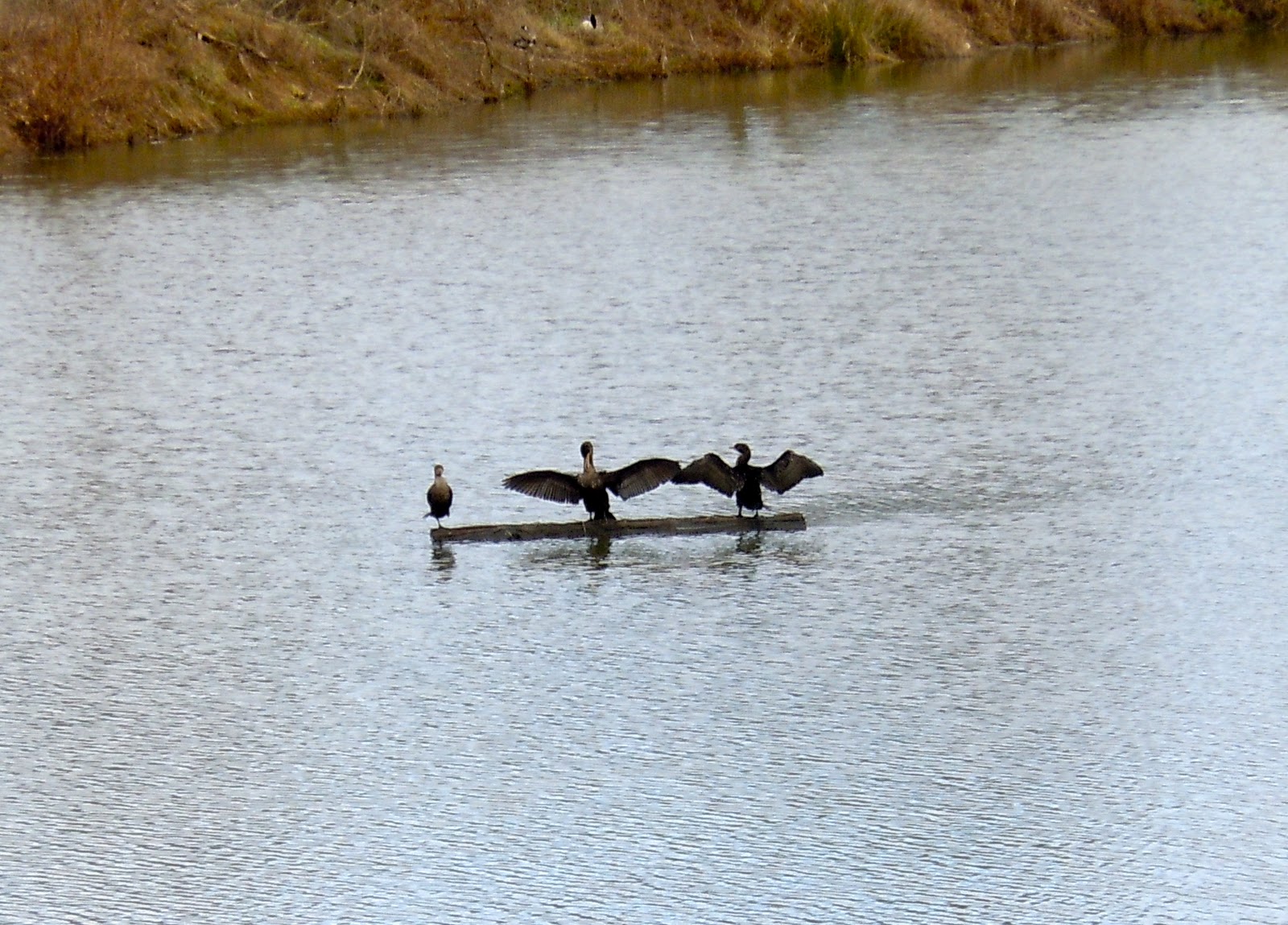
The geese have settled to a more sedate life and have come to a tentative agreement with the cormorants on the two-bird log. At least so it seems as there is a happy mixed occupancy this morning. It is to be hoped for that this avian detente will outlast the current spell of nice weather that is lulling us into a false sense of spring. I note that an Oregon Grape has a plethora of buds that are showing bright yellow. This is much too early, even if it is in a sheltered position behind the 'Portapotty'.

Literary Feast


Within Scottish enclaves around the globe there will be the traditional Burn’s Night celebration of the poet with the eating of haggis along with tatties and neeps and the drinking of good Scotch. With luck, there will be a piper to provide the music. The authentic beast is on the banned list for importation into the US, so we will have to make do with a pale imitation. Somehow a dish of lamb sausage with potatoes and rutabagas, eaten whilst a CD of the Band of the Scot’s Guards is in full flow, doesn’t evoke pictures of the highlands and the lochs even if the good Scotch is authentic and in liberal supply.

While Scotland is in the grip of its literary celebration, the good citizens of South Wales are getting organized and planning for a Spring rush of lustful toads in April. They are putting up road signs to warn passing motorists. I do hope that won’t result in motorists trying to avert their eyes. The locals are working out a rota where volunteers will go out with buckets to help the toads across the roads, but it can’t be a 24/7 effort so some toads will be rushing off to give their all for nothing. In mid-Wales they built toad-tunnels for last years rush and these were a considerable success. Why not in south Wales? Perhaps the economic crunch would mean that they would have to be toll tunnels for Mr.Tod.

Toads rushing around over south Wales looking for love are making epic journeys, but none are quite as remarkable as that reported for a female polar bear in the Beaufort Sea (http://news.bbc.co.uk/earth/hi/earth_news/newsid_9369000/9369317.stm). She swam for nine days looking for a suitable dining establishment. To cover 460 miles, non-stop in very cold water, is a remarkable feat. Her radio collar didn’t tell her followers if she had managed to pick up a snack on the way or what she thought of the new ice flow, though. Hopefully the Ringed Seals were plump.

Its Monday Again


A promise of blue sky in the west provides a bouncy feel to the morning. The mood has clearly spread to the ponds. A large group of geese are displaying their version of fratboy behavior, with a deal of splashing, preening and honking going on. A group of five ducks had taken over the two-bird log with no sign of its cormorant guardians anywhere. A playful goose tries to join them, but finds himself alone. Clearly that’s no fun, so he launches himself into the air. With no runway, he blows it and splashes and honks for a few yards before he can retract his undercarriage. 

On my return from the coffee pot I see that he has managed to find a friend and they have taken up residence on the log. Meanwhile one of the cormorants on the three-bird log has taken to the water and is circling around making the geese back off. This is clearly not a log that is up for grabs!

There are two herons at the ponds today, both hunched up and scraggly with their long neck feathers flapping in the light breeze. The ponds are still too cloudy for easy fishing.

With the jockeying for real estate on the ponds increasing as nesting time comes rushing to meet us, I wonder if the birds should take note of Dr. Sergio’s study from the Donana Biological Station in Spain. He has been studying black kites and their housekeeping habits. They build rather nice looking nests of twig and moss but then litter it up with our litter. Strips of white plastic bags are a favorite, but bits of paper or cloth will do in a pinch. Other black kites steer away from becoming neighbors rather like most of us are reluctant to move in next to a yard decorated with rusty old cars and dead kitchen appliances.  ‘Don’t Mess with Bubba’ is a message that seems to work in the avian world too.

A Fair Day in January


The Lane County Home and Garden Show had an encouraging emphasis of eco-friendliness and sustainability about the exhibits, along with a nice selection of arts and crafts. Not being in the market for home improvements, the best I could do was to purchase a pair of Alpaca-wool socks after communing with the delightful creature in today’s picture. 

Alpacas and Vicunas score very high on the cute scale. I would estimate at least a 5-Oooh rating. However, neither can quite hit the high of grey seal pups though. Those big winsome eyes are always  winner, and then that white furry coat settles it for most of us.

A heart-warming story this week was the report of three young seal pups from the Farne Islands on the northwest coast of England who went on a vacation to the Netherlands. With one only three weeks old, this seems rather precocious if not a tad rash. The trip was 350 miles and the North Sea in winter can be a little harsh even if you can dodge the constant stream of ships wandering up and down this nautical freeway. However go they did and no sooner were they sunbathing on the beaches of the Netherlands than they were sent home. Freedom of movement within the EU may have some age limitations attached or maybe they just needed their parents seal of approval.

Return to the Ponds

The sun was in a teasing mood and inviting us locals to try a restorative walk. Before I had traveled two hundred yards, it was back in hiding and remained there for the rest of the afternoon. I did the polite thing and pretended not to notice. First, I checked the river. It was higher than ever and running very fast. One of the benches along the bank had disappeared; either it is hiding underwater or has been swept away.
Although the pond level is still high, and may still be rising slowly, the cloudiness has fallen. The birdlife now seems to be returning with pairs of geese occupying prime sites on the banks and islands. The cormorants are back in place and drying out after fishing activity. The heron may not have done so well though as it has taken to a log instead of the bank. Contemplating the benefits of a vegan diet perhaps. 

Maybe though, he is feeling more fortunate than Gena from Dnipropetrovsk in the Ukraine. Poor Gena, while posing for a photo-shoot, yawned on being asked to smile, and then accidently swallowed a cell-phone dropped into her mouth by the would-be photographer, a Mrs. Golovko. Gena, an immigrant crocodile from Africa, is refusing to answer any more calls and is complaining that the ringing in her stomach is quite putting her off her food. Gena is currently eschewing favorites like live quail as they have been injected with laxatives. She is convinced that the photographer’s (Ms. Golovko) hurry to get her sim card returned with her contact list is just a passing fancy.


Micro-farming


There was a plethora of items in the media this morning on communication and cooperation in various species of wildlife. Very humbling for us humans as we usually assume that we invented everything. The most unexpected gem shining from the spoil was the letter to Nature (1) by Brock et al. They have been up to their armpits in the social amoebas known as slime mold. These characters live on bacteria and when the local supply and demand has gone critical, they gather together into a fruiting body – somewhat like their version of the Mayflower – and sail off on the prevailing currents to pastures new. BUT (and note that it is a big ‘but’) a third of the immigrants are farming specialists and carry enough bacteria with them to start new gardens and so prosper in their new world. One is left to wonder if the other two-thirds are lawyers.

Further up the food chain were items on communication of information within a group. Prairie dogs, for example, have a high-pitched squeak and thanks to NPR, I learnt that there is richness in those squeaks that we humans miss. Not surprising, as I have never learnt prairie dog and most foreign languages come across as a sonic blur to my untutored ear. Computers with microphones are much more adept at analyzing the noise. Prairie dogs apparently tell their friends and family the difference between a triangle and a circle. More exciting than that though is that they described people by their shape, or at least height and width, as well as by the color of the tee shirt that they were wearing as they paraded through the colony. There was no translation of the bulk of the chatter though so we don't know what they thought of the designs.

We were also reminded from a different station, that capuchin monkeys get teed-off and refuse to cooperate in monkey psychology tests if they get consistently short changed. Also that crows have great face recognition and ill pass on to their kids which nasty guy is likely to mess with their nests. There were items about chimps and baboons and one about sharks probably being color-blind (so they won’t be put off by the sight of blood?), but I wonder why there is such an element of surprise when these observations are published – shark items apart of course. Cooperation and communication are vital characteristics for species survival. Even animals that prefer to live alone get together for a good time occasionally, just like the rest of us.

Ref:
1. http://www.nature.com/nature/journal/v469/n7330/full/nature09668.html

Pondering the Depths


Bufflehead Flotilla

The morning chill is making my eyes water as I hike to the coffee pot this morning. The pond level is at the highest that I’ve seen it so far. The connective routes from sub-pond to sub-pond are now much broader. The islands have shrunk and some trees have their lower half submerged. A very turbulent inflow has turned the water universally brown with fine particulates carried in from the river.

The wildlife are very quiet this morning with a few disconsolate looking geese staring out across the water. The odd one finds the energy to honk in a half-hearted manner as I walk past. A small flotilla of Buffleheads are continuing to tough it out, but otherwise most of the ducks, geese, heron et al have moved off. Where to? The river is very high and turbulent and even more cloudy, so that wouldn’t be good. As I watch and wonder, a sole cormorant swoops in to waterski to a halt; the call of her home log being too strong to ignore for long, perhaps. With a drier spell of weather predicted, the river level should drop and maybe the ponds will have more excitement to offer.

Designer Genes


An interesting result of a genetic study carried out by Prof. Fowler and colleagues, which is published in PNAS (1), indicates that our genes influence our relationships. Assortative mating so that we tend towards the same set of genes doesn’t sound to surprising but taking it to the extent that we like to share genotypes with our friends seems surprising, at least to me. DRD2 is the beasty that sorts us out apparently. When I read that this is the one that is also associated with a tendency towards alcoholism, I began to see that the popularity of bars takes on a deeper meaning and singles bars must have an even deeper significance. The CYP2A6 genotype was shown to exhibit heterophilly, that is these are people that we wouldn’t like to hang out and drink with.

We need an iPhone App that stores our genotype information and can compare this with others in the same space. Bluetooth technology has a 30-foot radius and would be ideal. Think of the time and money that this would save, we would just have to give the bar a quick scan and our App would give us the probability of having an interesting evening. It would rate the bar on the percentage of the denizens that were boozy soul mates compared to the percentage that were going to tell us boring stories about work or their brother in law’s sister’s dog. Until the App is here, I guess I’ll have to rely on my old standbys of pheromones and non-verbal communication.

A real challenge comes with our Facebook friends. Should we publish some genotype information along with our favorite films and music? Would prospective employers want to compare your genotypes with others that would be in the same team as a compatibility check? Setting up ‘tiger teams’ in the workplace is well established, but are we going to see ‘metagenomic teams’, or better still ‘metagenomic tiger teams’, as the newest fad from the business consulting world?

Whilst sitting here, comfortably in my metagenomic world, I begin to worry about how epigenetics can play into this. If environmental factors can cause genes to become inactive/unavailable due to say modification of a histone tail or the addition of a methoxy group, and this reduction in activity can be passed on for a generation or two, is it possible that I could suddenly end up in a feud with my metagenomic group which could last through to my grandkids time?

Reference:

Collateral Gain


It is always fascinating to see that the collateral changes that we get alongside a planned environmental change are invariably unexpected. Ella Davies in the BBC Earth News today reports on the re-introduction of beavers in Poland. Now we have known, from the work of University of Alberta scientists carried out several years ago, that beavers are good for frogs. Beaver ponds are good homes for tadpoles and I’m sure that over a glass of wine in a bar, I would have been rash enough to predict that. But that beavers are good for bats would not have been on my list. I’m sure it was a surprise to the researchers at the University of Gdansk who spotted it.

Of course we have to climb the causal tree to find out why. Water of course is good for insect populations, so that might be it. But, surprise, the bats that hunt over water (such as Daubenton’s bat) aren’t favored. The reason? These bats use the water surface to reflect their hunting sonar to light up insects and the still water of the beaver ponds get a duckweed blanket giving a stealth surface that hides the insects. The favored bats are those that hunt high up among the trees. The thinning of the trees means fewer small branches and twigs making it easier for these species of bat to locate and catch insects.

It is a little over eighteen months since beavers were re-introduced to Knapdale in Scotland, so it is too early to see wildlife synergies, but a fine time to look to see if they develop. The UK’s bat population is in a pretty dire state and an army of beaver conservation volunteers would be a very cheap way to give them a hand up without increasing the tax rate. Also I’m sure that the current citizenship of Inverness wouldn’t do what their 17th century ancestors did – namely to hunt the beavers for their fur and eat their tails as a substitute for fish
 ( http://news.bbc.co.uk/2/hi/uk_news/scotland/glasgow_and_west/8187637.stm ).